The Spanish real estate sector is experiencing a time of contrasts. While home sales have posted six consecutive months of declines (with a 12% slump in May and 4% in June, according to notaries), prices remain at record highs. Resale housing, which accounts for over 80% of transactions, has climbed 15.6% year-on-year in August, reaching an average of 3,166 euros per square meter. That is 428 euros more than a year ago, according to Fotocasa data. This imbalance raises the question: are we at the market's peak, or simply catching our breath?
Madrid: record prices, but with less momentum
In the capital, the average price has risen 8.2% in August, hitting 6,624 euros per square meter. Thus, a typical 80-square-meter home now costs 529,920 euros. Although this marks a new all-time high, the pace has slowed compared to last year, when growth stood at 15.3%. In other words, the surge has been cut nearly in half, a clear sign of exhaustion.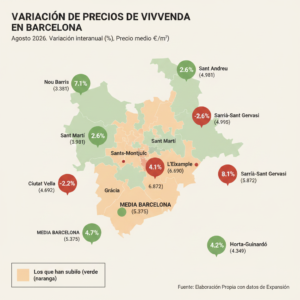
Barcelona: more modest increases and a widening gap
In Barcelona, the increase has been even more moderate: 4.2% year-on-year, far from the 9% recorded in 2024. The price per square meter stands at 5,375 euros per square meter, also at record levels. An 80-square-meter flat averages 430,000 euros, nearly 100,000 euros less than in Madrid. This difference is no coincidence: legal uncertainty and legislative changes have penalized the Catalan market, which previously followed a trajectory similar to Madrid's.Signs of a cycle shift
Despite the differences, both capitals point in the same direction: demand is cooling. In Madrid, transactions fell by 8.8% in June, marking twelve consecutive months of declines. In Barcelona, the drop was 4.4%, adding up to six months in negative territory. According to José García Montalvo, professor of Economics at Pompeu Fabra University, "households have reached the limit of their payment capacity", forcing sellers to moderate their expectations.Montalvo adds that Madrid and Barcelona act as a barometer for the rest of the country. "Increases will moderate because prices are unsustainable, but there will be no significant falls as long as the economy holds up", he explains. The underlying issue remains the scarcity of supply, which keeps prices elevated even with less demand.📰 News source: Expansión
📰 News source: Expansión